Jesus Won’t Turn His Back
Luke 4
When he came to Nazareth, where he had been brought up, he went to the synagogue on the Sabbath day, as was his custom. He stood up to read, and the scroll of the prophet Isaiah was given to him. He unrolled the scroll and found the place where it was written:
“The Spirit of the Lord is upon me, because he has anointed me to bring good news to the poor.
He has sent me to proclaim release to the captives and recovery of sight to the blind,
to set free those who are oppressed, to proclaim the year of the Lord’s favor.”
And he rolled up the scroll, gave it back to the attendant, and sat down. The eyes of all in the synagogue were fixed on him. Then he began to say to them, “Today this scripture has been fulfilled in your hearing.” All spoke well of him and were amazed at the gracious words that came from his mouth. They said, “Is this not Joseph’s son?” He said to them, “Doubtless you will quote to me this proverb, ‘Doctor, cure yourself!’ And you will say, ‘Do here also in your hometown the things that we have heard you did at Capernaum.’ ” And he said, “Truly I tell you, no prophet is accepted in his hometown. But the truth is, there were many widows in Israel in the time of Elijah, when the heaven was shut up three years and six months and there was a severe famine over all the land, yet Elijah was sent to none of them except to a widow at Zarephath in Sidon. There were also many with a skin disease in Israel in the time of the prophet Elisha, and none of them was cleansed except Naaman the Syrian.” When they heard this, all in the synagogue were filled with rage. They got up, drove him out of the town, and led him to the brow of the hill on which their town was built, so that they might hurl him off the cliff. But he passed through the midst of them and went on his way.
Does this passage seem odd to you? I can imagine that, in your century, it probably does. By your time, I am sure, the context of this event has been long lost. At least, I hope it has.
But to us, in what you call the first century, this passage speaks so much to us about who Jesus is. Yes, and about how different he is from other rabbis of our day. So very different!
And, unfortunately, it also speaks about us, the citizens of Nazareth, and really of our entire nation. It speaks of our misplaced pride in our heritage, and it speaks of our misunderstanding of the nature of our YHWH God.
First of all, who am I? Yes, you guessed it, I am a follower of Jesus, and I was present in the Nazareth synagogue on the day when Jesus visited. Actually, like many in the synagogue that day, I knew Jesus as he was growing up. He was a regular attender, as the scripture says, “as was his custom,” along with his parents, brothers and sisters. In fact, some of his siblings were present on this very day when he visited. So was his mother, Mary. To say that we were familiar with Jesus should be obvious, especially when you read about the reaction of the attendees.
Jesus had left Nazareth about a year before. I have to say that his departure caused some whispers in our village. Joseph, his father, had died about three years earlier and Jesus was the oldest son. So, you can probably guess that leaving Nazareth led some of our townsfolk to question his loyalty to his family, and especially to his widowed mother. In our culture, the oldest son has special responsibilities as well as special privileges. And don’t forget that we are a close-knit, small village whose families go back generations. There are very few secrets here.
But was the Jesus who returned home the same man as the one we knew growing up? I must say that the things we heard did not sound like the Jesus we knew. He seems to be following a path of becoming a rabbi, though not one tied to any locality. Instead, he appears to be itinerant, traveling across the Galilean hills, and visiting village after village. Capernaum seems to be a kind of home base for him, and we have heard about his healing power among the residents there. He seems to be something of a miracle worker!
I was happy to see Jesus. I can’t say that we were close friends, as I was a few years younger, but still, I looked up to him. But that was Jesus the carpenter, not Jesus the rabbi. And Jesus the rabbi was, we were to quickly discover, about to prove that he was no longer the carpenter who left us. No, he was not the same man at all.
He read from Isaiah and then made the remarkable statement about his being the fulfillment of the prophecy. As I was digesting that thought, some in the synagogue began to grumble. In effect, they were questioning how Jesus, the boy who was raised among us, and who, in their opinion, deserted his family, could now be, as a man, the long-awaited Messiah. I confess that I could not argue with them.
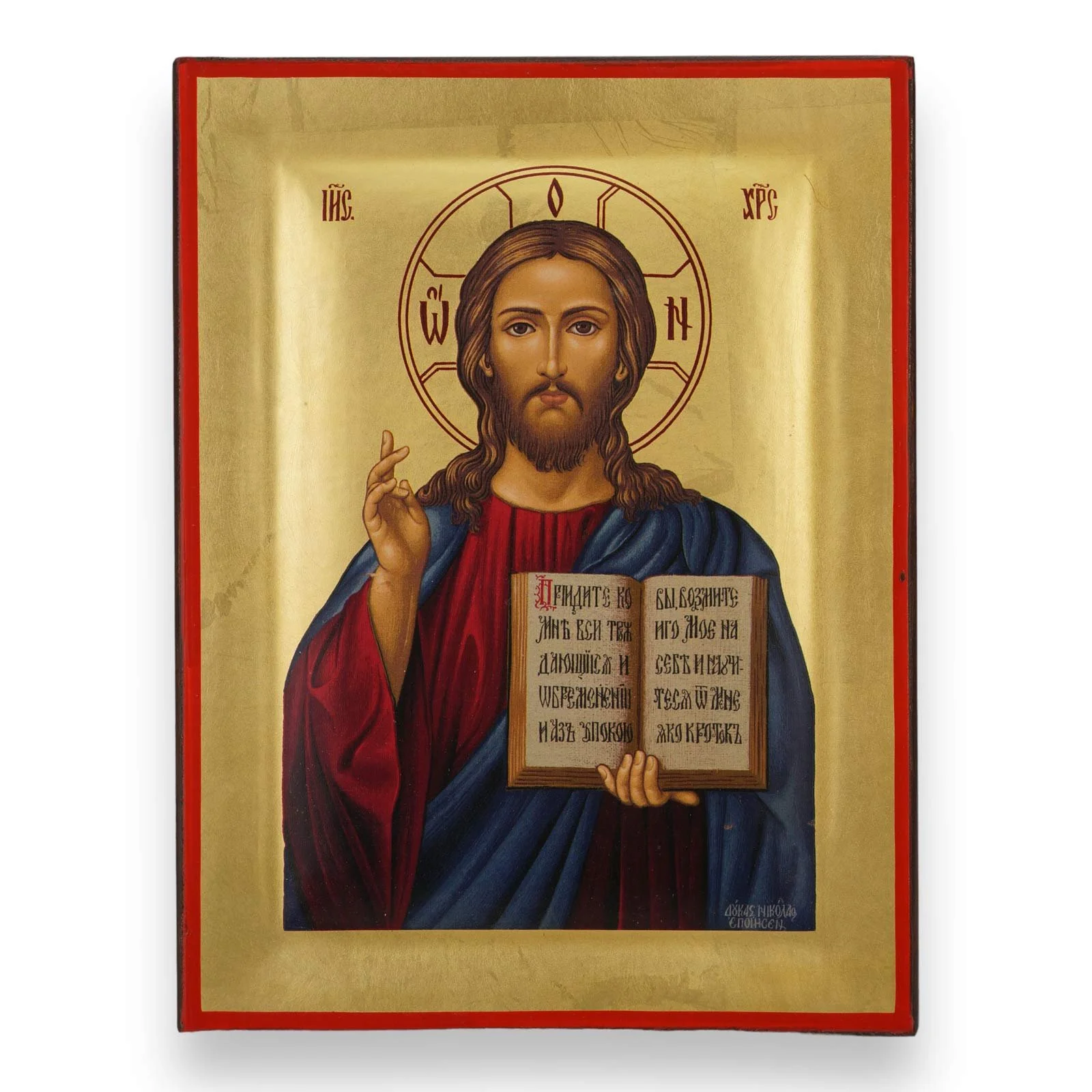
Christ the Teacher
Russian Orthodox Icon
Then, Jesus went even further, as if to poke a stick in our eyes. His “gracious words” turned to challenges to our faith. He questioned those in attendance who wanted him to put on a show of miraculous power. He reminded us that both Elijah and Elisha, who are still revered in our time, performed miracles outside the traditional boundaries of Israel. Both, you see, were rejected by their own countrymen, and so they went to the Gentiles.
Can you see how these comments incited rage among the attendees? The usually-quiet synagogue erupted in shouts and angry fists. I watched as the family of Jesus, confused and upset, could not mount any defense of him. In my opinion, in the chaos, they were as bewildered as the rest of us. Why would Jesus come home, appear in our synagogue, and openly insult us?
I have some theories about this, and I want to share them with you.
First, Jesus is a speaker of truth. Now that I have reflected on the events in our synagogue, I have come to believe that he was first of all, motivated to speak the truth to us. And what is the truth? Well, it’s hard to admit, but the truth is that our faith has lost its depth, replaced by pride as children of Abraham. Even after Jesus quoted Isaiah, the feeling in the synagogue was to see him perform, to show us a miracle like the ones we’d heard about. We didn’t really want to hear about the poor, the captives, the blind and oppressed. No, we wanted a show and I suppose that Jesus decided that we didn’t really want to take him seriously, to listen at a deeper level.
So, he told us the truth. If all we wanted was a show of miracles, and not the deeper truths that he preached, we would not see any.
And he went even further, citing examples from Elijah and Elisha, when they found a warmer reception outside of Israel than they did within it. That’s when our bruised pride incited the attempted violence against Jesus. Again, Jesus was speaking the truth, but it was not a truth that we wanted to hear. I have to add that his family was in shock.
Jesus could have complimented us. He could have stroked our pride, telling us how faithful we are. He could have reminded us that, as sons of Abraham, we are privileged over all other peoples. And he could have done what we wanted, which was to show us a miracle. Instead, in his own way, he confronted us with a truth that we didn’t want to hear.
It was striking to see how quickly the crowd turned on him.
But there’s one more thing:
When the people became enraged, Jesus didn’t argue with them. He didn’t match our rage with a rage of his own. Jesus never returned hate for hate. I think he must have decided that he had had his say and that was enough. I mean, Jesus doesn’t hate us. In fact, as he saw how we rejected his truth, he seemed more sad than angry. Yes, he was quite sad and I could see it in his face.
And that leads me to a final thought. I mean, why did he ever think to come to Nazareth in the first place? I’m sure he knew what awaited him here. But he came anyway, even if he could see that it would sadden him. Of course, I couldn’t know at the time how Jesus would face even much more rejection when he traveled to Jerusalem.
So why did he come home? Maybe it was out of duty, or maybe it was because of his family. But I don’t think so. What I think is that he came because he has a message that he wants everyone to hear: the same message that he quoted to us from Isaiah. Jesus really does care about the poor, the captives, the blind and oppressed. He hoped that we would too. And of all places, he did not want to leave out his own hometown from that message.
He could have turned his back on us. He could have decided that those of us in Nazareth are just not worth a visit from him. But Jesus came anyway, no doubt knowing what was likely to happen.
What I appreciate most of all about Jesus, in reflection, is not only what he said. No, what I appreciate most of all about him is that he would not turn his back on us. And I do not believe he will turn his back on anyone, including you, in your time, so far into the future.