Mark 14
Peter said to him, “Even though all fall away, I will not.” Jesus said to him, “Truly I tell you, this day, this very night, before the cock crows twice, you will deny me three times.” But he said vehemently, “Even though I must die with you, I will not deny you.” And all of them said the same. (Mark 14)
Why did it have to be Peter?
Think about that question, just for the moment. Why Peter? Why was it him? He was the most recognized leader among us, the most prominent one, the one who boasted of his courage. Why was it Peter who turned out to be the one who, in denying Jesus, shamed himself? Why him? What do you think?
Let me go back to the beginning. I was there, that night, at the meal. I was at the table with Jesus and the others. And let me tell you, the atmosphere was charged. I mean, we twelve may not have been the most intelligent of men, but you couldn’t miss it: something was about to happen, something terrible, something truly unbelievable. Jesus was telling us that he would be arrested and crucified.
He had told us before. But, as you remember, that was back in Galilee, and later, on the road. It was only when we arrived in Jerusalem that, firsthand, we witnessed the hostility aimed at Jesus. To say that it shocked us would not do justice to the hate that we saw displayed by our religious leaders.
And don’t forget: these were respected men, even feared. You must understand that their power and influence went well beyond our spiritual lives into every aspect of our nation. And we, of course, understood that their opposition to Jesus would likely extend to us as well.
But it was Peter, the fearless one, who boasted that he would remain loyal, no matter what. You may remember that he’d already done that once before, prompting Jesus to turn on him: But he turned and said to Peter, “Get behind me, Satan! You are a hindrance to me, for you are setting your mind not on divine things but on human things.” (Matthew 16)
And now, Jesus called him out again, predicting that, when the time came, Peter’s courage would fail him. And of course, as you know, his courage did fail.
Would Peter’s failure and shame cause the rest of us to reject him? Would he lose so much respect that he would remove himself from our fellowship? Would Jesus, after he was raised from the dead, punish Peter? Would he take him aside and have it out with him?
You may remember that Jesus, in part, did just that, taking Peter aside. Yet he did not punish him. You may remember the scene: back in Galilee, where seven of us were fishing, still trying to sort out what had happened in Jerusalem. Jesus arrived on shore, instructing us on where to find fish (we were empty-handed) and had made us breakfast. Jesus then took Peter aside. We all assumed that Peter would, at the least, be given a tongue-lashing from Jesus. In my mind, he certainly deserved at least that.
When they had finished breakfast, Jesus said to Simon Peter, “Simon son of John, do you love me more than these?” He said to him, “Yes, Lord; you know that I love you.” Jesus said to him, “Feed my lambs.” A second time he said to him, “Simon son of John, do you love me?” He said to him, “Yes, Lord; you know that I love you.” Jesus said to him, “Tend my sheep.” He said to him the third time, “Simon son of John, do you love me?” Peter felt hurt because he said to him the third time, “Do you love me?” And he said to him, “Lord, you know everything; you know that I love you.” Jesus said to him, “Feed my sheep. Very truly, I tell you, when you were younger, you used to fasten your own belt and to go wherever you wished. But when you grow old, you will stretch out your hands, and someone else will fasten a belt around you and take you where you do not wish to go.” (He said this to indicate the kind of death by which he would glorify God.) After this he said to him, “Follow me.” (John 21)
Yet it would seem that Jesus had not lost confidence in Peter. Their conversation showed that he still saw Peter as a leader, and that he was in no way removing him from his position of prominence. Why?
I have thought a lot about this exchange and why Jesus kept his faith in Peter. Why did he? Read it again, and you will see that Jesus stuck with Peter because Peter loved him. It was as simple as that. Peter’s courage may have failed, but his love did not. Peter truly loved Jesus, and that’s why his failures turned him into a broken man. He deeply cared for Jesus.
And I have also considered why, of all of us, Peter was the one who so publicly lost his courage. Yes, why did it have to be Peter?
You see, the choice of Peter, the proud boaster, as the one to lose his courage and fail in his loyalty to Jesus, was a lesson to us all. In God’s plan, it had to be one of us, and so it was Peter. And I believe, in showing us the failure of the most prominent one of our company, we all could see ourselves doing the same, or worse. After all, “and all of them said the same” (Mark 14) but then we ran into hiding while Peter followed Jesus.
For me, it was instructive to see Peter go through this trial. And it was even more instructive to understand why Jesus continued to see Peter as vital to his Gospel message. If our most prominent member could fail so miserably and still not lose his place, then any of us could do the same. And of course, all of us, in one way or another, did fail. For me, many times.
But the faith of Jesus never fails. He never gives up on us. He chose us and he will choose you, too. And despite any and all failures on your part, you can count on Jesus.
You may wonder if Peter’s courage ever failed again, after this incident. I think you know the answer.
But if you need convincing, there is one more story that I can share with you. I cannot guarantee that this story is true, so be forewarned.
It happened, years later, on the outskirts of Rome. Peter had gone to Rome to help build churches. And in doing so, he found himself a target of the Roman authorities. You see, members of our faith, called The Way, were persecuted in Rome. Many were living in the catacombs beneath the streets. Preaching about Jesus, as Peter was doing, was dangerous.
He could feel it coming. We all knew it and we warned him, that he would be arrested and possibly executed for preaching Christ as a king and for not worshiping the emperor. The smart thing was to flee the city, finding safety in the countryside. Then, later, perhaps, he could return. So, he left.
Peter was on the run, on the Appian Way, leaving Rome, when he ran into Jesus. Yes, it was the Risen Christ. And what’s more, Jesus was carrying a cross into the city.
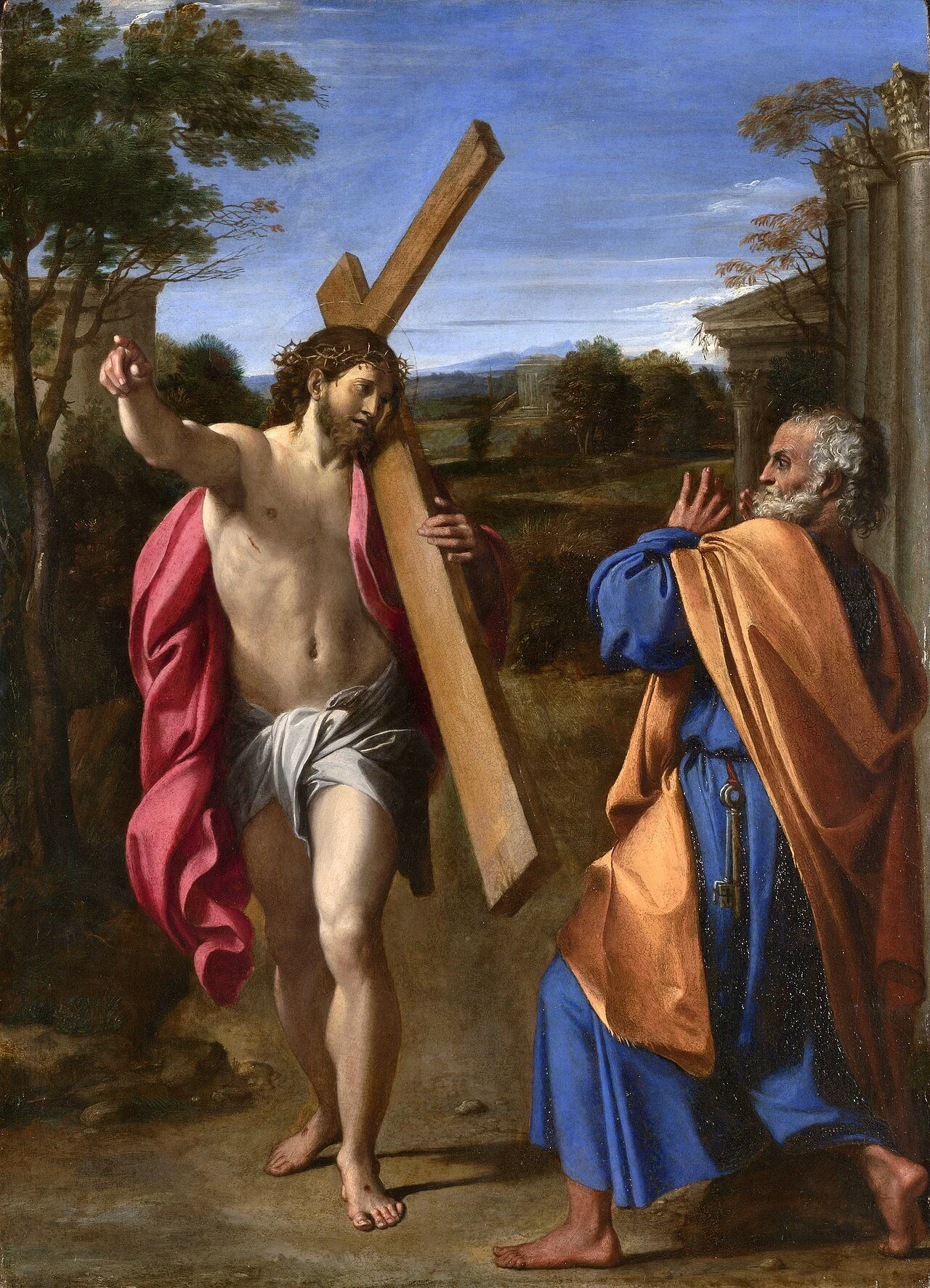
Domine Quo Vadis?
Annibale Carracci 1602
“Quo vadis?” That was Peter’s question, translated into Latin, the language of Rome. “Where are you going?”
“To Rome, to be crucified in your place,” was the reply of Jesus.
Again, Peter’s courage had failed him. And again, Jesus had the opportunity to call him out, shame him or even punish him.
But Jesus did not need to do that. Peter got the message and he turned around.
You know the rest. Back in Rome, Peter was arrested and crucified. He refused to be executed in the same way as Jesus, just out of his love and respect for his Lord and friend. And so, he requested to be crucified upside-down. Peter did not want to be compared to Jesus in any way.
Even if this story cannot be verified, it still holds a truth for all of us. Our God has faith in us, even when we don’t. Our God will pick us up when we have fallen. Our God will not give up on us, even when we are broken in failure and shame.
Our courage may fail. In my experience, it’s almost guaranteed. But God’s love and God’s faithfulness never will.
So, it did have to be Peter, don’t you see? It had to be the most prominent, the boldest one, the one we all looked up to. He had to be the one who fell, so that we could see Jesus pick him up and restore him.
Just like he did for me. And just like he will do for you.