She Did What She Could Part 2
Mark 14
While he was at Bethany in the house of Simon the leper, as he sat at the table, a woman came with an alabaster jar of very costly ointment of nard, and she broke open the jar and poured the ointment on his head. But some were there who said to one another in anger, “Why was the ointment wasted in this way? For this ointment could have been sold for more than three hundred denarii and the money given to the poor.” And they scolded her. But Jesus said, “Let her alone; why do you trouble her? She has performed a good service for me. For you always have the poor with you, and you can show kindness to them whenever you wish, but you will not always have me. She has done what she could; she has anointed my body beforehand for its burial. Truly I tell you, wherever the good news is proclaimed in the whole world, what she has done will be told in remembrance of her.”(Mark 14)
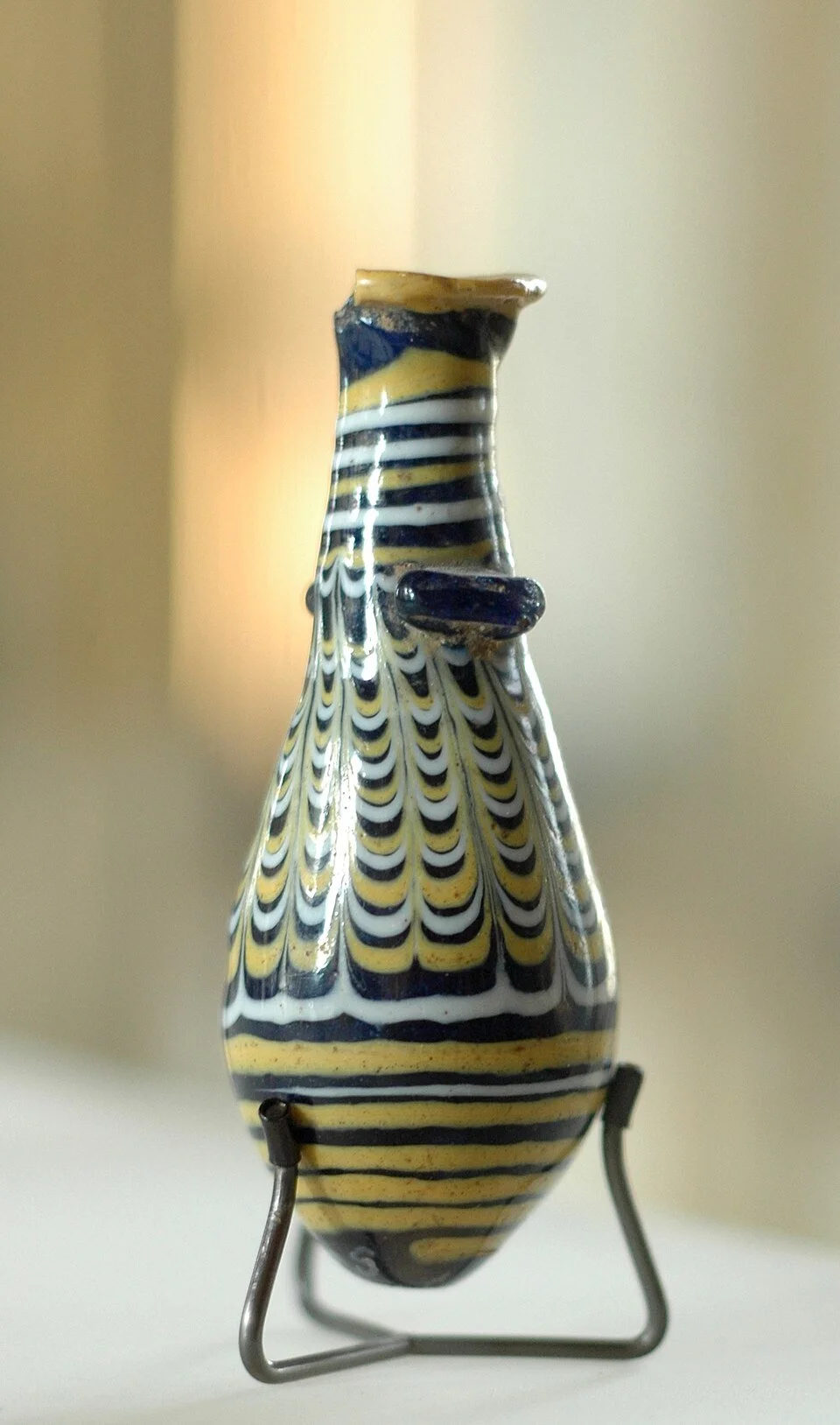
Alabaster Jar
1st/2nd century BC (Louvre Museum)
I know that you know this story. As Jesus said, it “will be told in remembrance of her.” But there’s quite a bit more to it, and I am writing to you from the first century to share what I know.
You surely understand that there is confusion about the identity of the woman. In this accounting, she is simply “a woman.” But, in another, she is named as Mary, sister of Martha and Lazarus, and in still another, she is not named but is described as a “woman who lived a sinful life.” In our day, that suggests a life of prostitution.
But you might imagine that, in addition to questions about her identity, there were many other, deeper questions. I can answer some of them, but not all. And you may have your own answers too, and that is perfectly fine.
So, who was she, really? Why did she do this? What motivated her to spend so much? Was she saving the ointment for some other use? Was this just an impulse on her part or had she planned it? Did she really need to pour out all of it, the entire contents, on Jesus? You may also wonder about the aftermath of this event. Afterwards what happened to her? Did she become, in a way, a leader of our faith, famous because of the extravagance of her action? Was she admired?
As I said, I can answer some of these questions. And I also have some theories about the others. And if there is any way, I’d love to hear your thoughts!
First of all, would you be surprised to learn that the woman in this account was my grandmother? Well, you shouldn’t be, because that’s why I am able to add so much to the story that you can read in your time. I heard it firsthand from her and am faithfully reporting it on to you.
I hadn’t yet been born, but later, as a young child, I began to ask questions about her act of love. It was only then, years after the fact, that she was willing to speak about it. I am certain that she wanted no notoriety as a result of her extravagance. Actually, she deeply felt the criticisms of the others who objected to her act. And even afterwards, her sense of guilt did not diminish until years later. That’s a shame, in my opinion. Why? Because, first of all, their reaction seemed to go against the gratitude shown by Jesus, and second, because their disapproval did not end, even after Jesus called them out. You see, for a time, she was widely known in our village as the crazy woman who did a crazy thing. Instead of feeling good about what she’d done, she allowed their accusations to spoil what was, in fact, a beautiful act.
Her reputation did not easily fade away. And if you are wondering, no, she was never asked to join the leadership of the new faith, nor was she ever given the positive recognition that she received from Jesus. It was almost as if only he could fully understand the depth of her desire to honor him. The others? They seemingly saw only the practical, monetary value of the ointment.
Years afterward, I began to ask her about it.
“Grandmother, why did you do this? Had you been thinking and planning it for a while?”
“No, child, actually, the thought had not crossed my mind until that very day. Honestly, I cannot tell you why I took the ointment to the dinner and why I anointed Jesus as I did. It just seemed to be the thing to do, as if I was being called to something that I could not fully understand.”
“Where did you get the expensive perfume? I heard that its value was equal to a year’s wages.”
“My parents gave it to me, as a gift to save for my marriage. You see, at the time, I was engaged to your grandfather. Our wedding was only weeks away. The perfume was to be used at our wedding and during our honeymoon. But when I heard about Jesus coming to our village, everything changed, and I somehow knew that it had a higher use.” She winked and said, “And I never told your grandfather what it was really for. So, you keep quiet, you hear?”
“What did you know about Jesus?”
“I knew he was special. I knew that he was here to call us to our YHWH God in a deeper way, directly to our hearts. I knew that he was all about love, that we should love God and love our neighbors. Beyond that, I actually knew very little.”
“Yes, it seemed that you really didn’t know all that much. But you did it anyway, didn’t you?”
“You see, I didn’t need to know. This was something much more of a feeling and not knowledge. Yes, I felt very called to listen to him, to admire him, and, in a way, to honor him in the eyes of our people.”
“What do you mean?”
“Jesus, you see, didn’t have that many followers. Yes, he drew crowds, just like John the Baptizer did before him. But most of them were just curious. They listened, but nothing much changed. And worse, our religious leaders opposed Jesus, and they reviled him. To them, he was a threat, calling out their hypocrisy. So, you see, at the time of my act, he really lacked much of a loyal following. Somehow, I could feel his sense of disappointment, that so few took him seriously. In a way, and despite the crowds, he seemed like a very lonely man. And so, I wanted to let him know how much I admired and yes, even loved him. And I wanted to do it openly, in the full view of his disciples and of anyone else who might take notice.”
“I see what you mean. Grandmother, what you did surely took a lot of courage on your part.”
“You might think it did, but looking back, I don’t remember it that way. Perhaps, in the moment, I was given courage from some hidden source. I do understand how out of the ordinary it was, for me, a woman, to approach a man and anoint him as I did. And how strange it must have looked when the others saw me pour out the entire contents of the ointment, not holding any back for my own use. To tell you the truth, I almost didn’t realize that I’d poured it all out until it was completely gone!”
“Looking back from today, what do you think it all meant? Are you happy that you did it?”
“Well, to some, I am still the crazy woman who did a crazy thing! I suppose I will never live that down. And when I look back to that day, it seems a bit hazy, I mean, it was by no means an act that I had ever contemplated doing. The calling that I felt was so strong and so immediate, and of course, it even went against any possible practical thought.
But that’s what makes it so memorable. Because I know, deep down, that our God called me to act. I was used by him in a way that went far beyond any personal power of mine. It was special because I knew and even now, I am more convinced that God used me, yes me, to do a wonderful thing. All along, it was his doing and I was just the vessel of God’s plan.”
“Was there anything else?”
“Yes, there was one more thing. Looking back, I know that Jesus really needed this. He had every reason to be discouraged. Of course, the reaction of the onlookers, even including his own followers, men who’d been with him for three years, was discouragement enough.
But there was more. As Jesus said, my anointing was preparing his body for burial. He knew what was coming. And, of course, he was preparing himself for an awful trial, rejection, and crucifixion. My act of anointing him was, I believe a message to Jesus from his heavenly father, telling him that he was loved beyond measure and that his father would never abandon him.
It’s funny, isn’t it? The collective wisdom of the crowd was that I was pouring away ointment worth a year’s pay when I anointed Jesus. To them, I was throwing it away; it was a waste. Yet, I did it, and, you know, I am proud of that! Because Jesus, after all is worth so much more than a year’s pay. In fact, none of us can possibly calculate how much Jesus is worth!”
“What is Jesus worth to you?”