Satan’s Throne
Revelation 2
“And to the angel of the church in Pergamum write: These are the words of him who has the sharp two-edged sword:
“I know where you are living, where Satan’s throne is. Yet you are holding fast to my name, and you did not deny your faith in me even in the days of Antipas my witness, my faithful one, who was killed among you, where Satan lives. But I have a few things against you: you have some there who hold to the teaching of Balaam, who taught Balak to put a stumbling block before the people of Israel, so that they would eat food sacrificed to idols and engage in sexual immorality. So you also have some who hold to the teaching of the Nicolaitans. Repent, then. If not, I will come to you soon and wage war against them with the sword of my mouth. Let anyone who has an ear listen to what the Spirit is saying to the churches. To everyone who conquers I will give some of the hidden manna, and I will give a white stone, and on the white stone is written a new name that no one knows except the one who receives it.” (Revelation 2)
What is Satan’s throne and why is it so important? You may be surprised to find that Satan has a throne and that it’s in Pergamum. Read on and you will understand why the Risen Christ used these words.
Actually, it’s not exactly a throne in the usual sense. It’s more, much more. What the term refers to is an altar, one dedicated to the Greek gods, especially Zeus and Athena. And it is large, almost the size of an actual temple, with images of Greek gods lining its borders.
It’s true, we are “living” with the altar. Our first bishop, Antipas, known as Antipas of Pergamum, was martyred in the vicinity of the altar. He had stood up to the Romans, who insist on worshiping their emperor. They killed him by burning him in a brazen bull, a most especially painful death. I am sure that they did so as a warning to our small community of Christ followers.
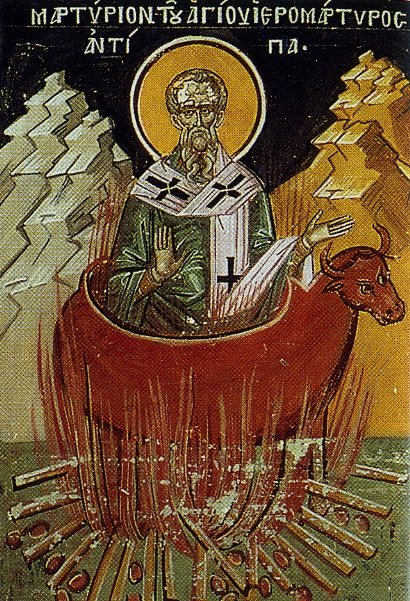
Execution of Antipas
Rousanu Fresco
So why did the Risen Christ call out the altar as “Satan’s throne?” I will come back to that question, but first, who am I?
I am the wife of Antipas. Yes, his wife, and I can tell you that we were married for over thirty years. Now, as his widow, I am in a permanent state of mourning. I will continue to mourn him for the rest of my life.
You might think that the authorities who killed Antipas would come for me, too. Perhaps. In any case, I live with the fear that they will. And as a result, I must carefully consider what I say and do. And I must also guard myself in any public appearance.
So, back to the question of Satan’s throne. First of all, you must understand the culture in which we, our infant Christian church, find ourselves. Pergamum is an ancient city, a large city, and a very diverse city. In Pergamum, you will find strict advocates of the worship of the emperor. You will also find Jews, and you will find, least of all, Christians like Antipas and me. But even within our small Christian community, you will find diversity. The Risen Christ mentions it in his “letter” which you can read. Some in our fellowship teach that we must blend into the larger culture, which you will call pagan, including worship and sacrifices to other gods, cult prostitution and acquiescence to the cruelty of our Roman masters.
Others among us, and I am of this faction, believe such thoughts are adulterous, diluting the true faith that was taught, first by Paul and later, by John, the author of the letter to us. We oppose the drift of our faith into an all-to-easy co-existence with the evils found in Pergamum.
In a way, it’s shocking to see how quickly our small fellowship became so divided. I mean, it didn’t take long, no more than about ten years. And I have to say that I wonder about the motives of some who tried to lead us away from our roots.
Let me point out one who led some of our group astray. His name is Lucius and he is the one, I am sure, whom the Risen Christ compares to Balaam. And, as I will explain, his distortions of our faith led to the death of my husband.
Lucius is an ambitious man. Very ambitious. He started a business selling olive oil and he did quite well, mostly with customers in our immigrant Christian community. But he wanted to expand into the broader Pergamum market, and he was willing to compromise his faith to appeal to the larger pagan population.
And it worked. Lucius began to appear at pagan festivals, participating in their rituals at the altar, and selling his olive oil to anyone who would buy it. He sold to the Roman authorities and became their favored supplier. And as his business expanded, he employed workers from the pagan community. A few of our Christian members also joined him, placing themselves, along with Lucius, in opposition to the faith taught us by Paul and John.
“Come join me, and we will all get rich,” he said, and in particular, inviting Antipas, who was already respected as the leader in our fellowship. “You can observe the ritual practices of the pagan people and still be a faithful Christian. I promise! It won’t change anything! And as I said, you will get rich!
“Antipas, if you join me, we can grow this business beyond our wildest dreams,” he said, hoping to persuade my husband to compromise his faith. “You are respected, and joining my business will help it grow. So, put aside your reservations and join me!”
But Antipas refused, and it set up a battle of sorts between the two men. Over a period of months, the conflict grew as Lucius attracted more from our community into his business. At the end, only a few continued to follow our faith as taught by Paul and John.
The conflict came to a head at the altar. It was during one of the pagan festivals, and Lucius was there, selling his oil to the pagan worshipers, and fully engaged in their rituals. Antipas was also there.
“Lucius,” he cried, “You are compromising not only your own faith, but you have also become a stumbling block to the faith of others. They are following you to their destruction. Your ambition has blinded you to what is important. Repent, rejoin our fellowship and you will be forgiven and welcomed back.”
“I’m too busy making money to reply to you now,” responded Lucius. “But don’t worry, I will. Your faith is out of date, old man, and, as you can see, no one follows what you say anymore.”
It was only a week later that my husband was arrested by the Roman authorities. His trial, if you can call it that, was a sham, with witnesses, including Lucius, claiming that Antipas spoke against the emperor and against Rome, and that he incited violent opposition.
The guilty verdict came quickly. Antipas was told to retract his statements, publicly curse Jesus Christ, state his allegiance to the emperor as a god, and if he did, he’d be jailed for time and then freed.
You know the rest. Antipas refused and was executed. As I said, his execution took place at the very same altar where he argued with Lucius. That’s why, I am sure, that the Risen Christ called it “Satan’s throne.”
And the aftermath? What happened next?
Surprisingly, many of those who’d followed Lucius returned to our faith community. I believe the courage of Antipas shocked them, turning them back to our faith, and exposing the darkness into which Lucius had fallen. Ironically, Lucius had believed that getting rid of Antipas would help him to take the role of bishop, the position that had been held by my husband. He mistakenly thought he could be both a business leader and spiritual leader at the same time. Instead, the death of Antipas had the opposite effect, rendering Lucius alone and outside of our fellowship. We have welcomed back those who had joined Lucius.
What does it all mean? For me, it means that the Spirit of Christ will not be silenced, not even by the darkness of Satan. It means that truth will eventually win out over falsehood. And sadly, for me, it also means that a price will be paid for the light and truth of Christ.
It was a costly price for Paul, who was also executed for his faith. And yes, for John, who has been exiled. And now for Antipas, the cost was his life.
Of course, the highest cost paid for the light and truth of Christ was the price paid by Jesus himself. No one will ever pay a higher cost than that!
And what about you?
You, too, may be living in a time of darkness, like us. If you are, you will be tempted to relax your faith by following the dictates of the culture, even of your own government. My hope for you is that you will not make a god of your business, your culture or your government. You can have only one master and that master is our God. I hope you will follow the example of Antipas and stand for your faith, even in the face of opposition. And please know that, across the centuries, I am praying for you.