Thyatira
Revelation 2
“And to the angel of the church in Thyatira write: These are the words of the Son of God, who has eyes like a flame of fire and whose feet are like burnished bronze:
“I know your works: your love, faith, service, and endurance. I know that your latest works are greater than the first. But I have this against you: you tolerate that woman Jezebel, who calls herself a prophet and is teaching and beguiling my servants to engage in sexual immorality and to eat food sacrificed to idols. I gave her time to repent, but she refuses to repent of her sexual immorality. Beware, I am throwing her on a bed, and those who commit adultery with her I am throwing into great distress, unless they repent of her doings, and I will strike her children dead. And all the churches will know that I am the one who searches minds and hearts, and I will give to each of you as your works deserve. But to the rest of you in Thyatira, who do not hold this teaching, who have not learned what some call ‘the deep things of Satan,’ to you I say, I do not lay on you any other burden; only hold fast to what you have until I come. To everyone who conquers and continues to do my works to the end,
I will give authority over the nations,
to rule them with an iron scepter,
as when clay pots are shattered—
“even as I also received authority from my Father. To the one who conquers I will also give the morning star. Let anyone who has an ear listen to what the Spirit is saying to the churches. (Revelation 2)
My name is Pavlos and I live in Thyatira. There is really nothing especially notable about me that you might have heard, and I’m sure that by the time you finish this letter to you, you will definitely agree! But anyway, please, do read on.
First, a bit about my city, Thyatira. It’s a beautiful city, located in the ancient kingdom of Lydia and now, of course, a part of Rome’s empire. Thyatira is a city of trade, including many guilds of workers employed in fine goods. We are especially known for the purple dye that is made here, and which is famous throughout the empire in the clothing articles of royalty.
I am a member of one of the guilds, the tanner’s guild. And that’s where I met the Apostle Paul, who, along with a man named Silas, brought the Christian faith to our city. Surely you, in your time, have heard about these men. At least, I hope you have, because, to us, they are very important persons. You see, it’s thanks to them, that we now follow Jesus of Nazareth as the Son of the God of Israel.
We also know of another disciple, a man named John, who is the author of the letter you just read. Unfortunately, Paul was executed in Rome and John was exiled to Patmos, just in case you were not aware. It seems that following Jesus can be a dangerous undertaking!
So, back to the letter, which John wrote to us, passing on the words of the Risen Christ. When you read the letter closely, you can’t miss two significant parts. First is the mention of what the Risen Christ calls “works.” That word is repeated four times in the letter.
And please don’t misunderstand what is meant by the term “works.” Please don’t think that it means some great accomplishment, like building a temple or becoming powerful political leaders. And clearly, “works” does not mean that we have somehow overthrown our Roman masters. Those types of works, we are told, are what the Jews of Israel expected of their Messiah. And when Jesus did not perform to their expectations, they had him killed.
No, the letter to us is clear about the true meaning of works: “your love, faith, service, and endurance” are the things that the Risen Christ defines as works. These, you must agree, are not works of triumph, as if we had won a battle against an enemy army, but instead, they are works of humility and caring. Just like the works of Jesus himself.
I have to say how pleased we were to read his words complimenting our works.
But of course, in reading the letter, you can easily see a second significant part. And these words are not so complimentary.
No, these words refer to a woman in our fellowship, a woman named Philippa. Yes, that is her real name and perhaps you can guess why the Risen Christ called her Jezebel. Because, if you are up on your history of Israel, you no doubt know of Jezebel, an evil queen who led people away from their true God into the worship of idols. And even more, she promoted promiscuity, just like Philippa, who unfortunately has built a following among members of our church.
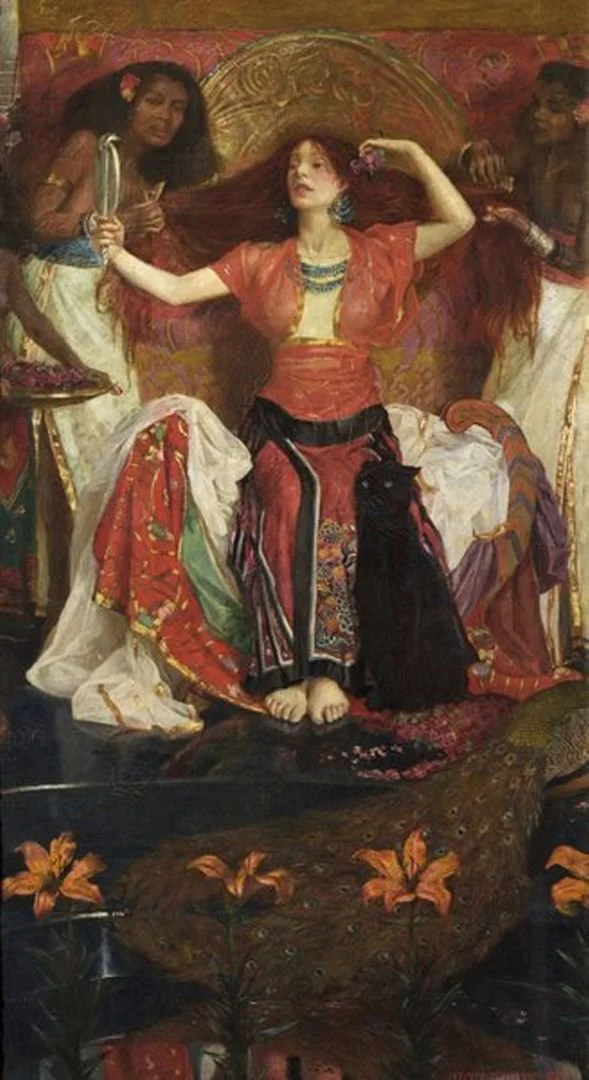
Jezebel
John Lison Byam Shaw
In the words of the Risen Christ, we needed to act, and to our shame, we did not. And as you read the letter, you may conclude that now, it’s too late, because Christ seems intent on dealing with Philippa all by himself. So, we are guilty of not acting when we should have. She clearly has aligned with our enemy, Satan, and has led many astray. As a result, our church is severely divided.
I have to say in our defense that we didn’t know what to do about Philippa. She is, by most accounts, a very charismatic person. She can be quite charming, in fact. In a way beyond my understanding, some are drawn to her commanding presence. She can speak with such passion, making grand pronouncements, and she has persuaded many in our fellowship, who see her as a prophet who should never be questioned.
It’s true, some of us did see past her image as a strong leader to see the evil inside. I don’t know if you believe in demons; until we began to see Philippa for who she really is, I did not. But now, I see no other explanation for her hold on some of our members. It’s not too strong a statement to say that some in our tiny church actually worship Philippa, almost as if she were a god. How can they be so blind?
As her stature grew, Philippa’s behavior became even more extreme. It’s true, as the Risen Christ said, she began to call herself a prophet. And it’s also true that sexual promiscuity was part of her appeal. Not attempting to hide it, she openly promoted her lifestyle to our church. She did, as the letter states, also encourage our members to eat food dedicated to idols.
And as her behavior veered further away from the teachings and the model of Christ, she projected herself as a champion of our faith. For example, she began to pray long and passionate prayers at every opportunity. Usurping the role of our pastor, she began to preach outside of our weekly services. And she publicly claimed that her behavior was the model for all of us to follow. Even some of our elders testified to her powers, claiming that she was “sent by God.”
As a result, those who had been “beguiled” by her were drawn ever deeper into her web, believing that following Philippa would be pleasing to our God. Obeying her seemed, to them, as if they were obeying Christ himself.
As I said, some of us could see Philippa for what she was. To us, it was so very clear. We tried to tell her followers. But her hold on them was so strong that we were powerless to open their eyes to what was happening.
Christ’s words in the letter from John have now set the record straight. Philippa has been exposed, as a few of us predicted, as a corrupt fraud, nothing more than the Jezebel of ancient Israel.
Christ’s letter tells us that he will take care of Philippa, “throwing her on a bed” and disciplining those who support her corruption. And the rest of us? We are told to “hold fast to what you have until I come.” But that’s hard. Mustn’t we do something about Philippa? Or must we wait until God himself acts against her?
Let me close my letter to you in your time with this:
Hopefully you, in your time, will never be called to deal with a “Philippa.” But I have to ask: can you relate at all to our situation? I’d love to know what you think. In your time, are there corrupt individuals who, like Philippa, seem to have an unhealthy grip on people who, in their innocence, are “beguiled” by evil? I hope not. But I do have to wonder if such people, like Philippa, might be part of human nature. Perhaps they are nothing more than a test of our faith in a Holy God who spurns the powerful and promotes the humble. Perhaps, I am afraid to wonder, if every generation might have its own “Philippa.”
If so, I will pray for you in your time. And as for us, please pray for us in our time, that we may see the work of the Risen Christ as he restores our fellowship.